Here's How You'll Be Able To Start Understanding Qur'anic Arabic In Just Three Short Weeks!
Here's How You'll Be Able To Start Understanding Qur'anic Arabic In Just Three Short Weeks!
Dear Seeker of Knowledge,
Here's the big misconception...
We're told that learning Arabic happens through gradually progressing from the simple to the complex.
In other words, the first thing you need to learn is how to say "this" and "that" and what's the word for house and what do we call a chair.
Then you should move to commonly used conversational elements like how do you ask someone their name and where they're from.
By around the 7th lesson you will have learned the major pronouns and have a few dozen commonly used words within your vocabulary.
Lesson 8 will go on to introduce verbs for example by first showing them being used within sentences and following up with exercises.....you get the picture.
Are You Making This Big Mistake in Learning Arabic?
In reality, what keeps most students stuck isn’t a lack of effort. It’s being trapped in basic grammar for far too long.
Basic grammar focuses on low-impact material: isolated vocabulary, noun-categorizations (e.g., gender, plurality types), and grammar rules that are easy to explain but have limited real-world application. You can spend months (even years) in this zone and still not be able to read a single page of real Arabic text.
High-impact grammar, on the other hand, is the 20% of rules and patterns that do 80% of the work in real comprehension. These are the mechanisms that make Arabic unique:
- • How vowels and patterns carry the majority of meaning.
- • The grammatical structures that recur in almost every sentence you’ll ever read.
- • The essential morphology (sarf) patterns that unlock the language’s logic.
When you learn this high-impact core first, you get the “big picture” of how the language actually works. Then, every new rule or word has a place in that framework. Nothing feels random, and you build momentum fast.
The Single Biggest Cause of Failure
The single biggest cause for failure in learning classical Arabic is trying to progress from the simple to the complex without having this big-picture understanding. The fastest, most results-certain approach is to isolate the high-impact core from the language and learn that first.
So How Do We Identify the High-Impact Core?
It's simple. Not all rules and lessons are created equal. In fact, the “80/20 Rule” states that you can expect 20% of your efforts to give you 80% of all the benefits you ultimately achieve.

This is especially true for the Arabic language. It has a very clear core which consists of roughly 20% of all the rules in the 3 sciences of Grammar (nahw), Morphology (sarf) and Rhetoric (balagha).
The rules that belong to this 20% core have the broadest application by far. These are the fundamentals of Arabic that you would expect to encounter in practically every sentence.
But within this 20% core, there is an even DENSER inner-core which we call the “Core-4″. Without getting caught up in math, re-applying the “80/20 Rule” with the 20% core, we get an inner core of no more than 4% of all the total rules in the 3 sciences. This 4% inner core accounts for over half of all benefits!

And it is the ability to properly capitalize on this very concept that allows students in our program to grow at an exponential rate. A sister who studied Arabic at Harvard university and subsequently at our intensive puts it best:
… Because of that, in one day of class I learned more than I learned in an entire YEAR of Harvard…. What you need in a class is someone to explain to you how the language WORKS…. In only a few days of the Shariah Program, people were starting to read Arabic fluently … they had already learned what each part of the sentence was, like: this is a past tense verb/this is a noun/ this is a command to a man/ this is an adjective referring to the feminine noun). That does NOT happen in university Arabic until well after the first full year….
Yes, properly capitalizing on the “80/20 rule squared” allows our students to learn mind blowing amounts of proper and well-structured Arabic in mere days. This is what makes the Shariah Program unique and its curriculum one of the most sought-after in the Western world.
OLD WAY
Basic Grammar Trap
Your current approach to Arabic that's holding you back in all sorts of ways:
NEW WAY

Where you finally break through the start-up phase and experience the following:
How It Works
The following 7 steps summarize how we'll get you out of the beginner phase and eventually help you achieve incredibly high levels of proficiency:
STEP 1: Study the CORE and Central Theme of How the Language Works
When you learn this high-impact core first, you gain a bird’s-eye view of the entire language. Every new rule or pattern isn’t just a random piece of information. It’s a missing part of the big picture that clicks neatly into place and makes your understanding sharper and sharper.
STEP 2: Begin Type 1 Guided Reading in the Third Week of Class
Text: Qasas an-Nabiyyeen 1-2
From Week 3, you begin Type 1 Guided Reading, applying your core grammar and morphology in a real text while continuing to build that foundation. This type of guided reading is designed to teach grammar and morphology in context, bridging the gap between theory and use.
While working through the Qasas books, the rest of grammar is taught informally — no textbook — but through carefully crafted slide presentations, similar in style to my 3-hour workshop on YouTube. At carefully calculated points during the semester, you’ll be introduced to:
- • Noun categorizations.
- • Verb forms and irregularities (ajwaf and nāqiṣ morphological rules).
- • Muʿrab vs. mabnī.
- • The various kinds of plurals.
- • Nested structures — handling prepositional phrases and adverbial structures when no clear verb is nearby.
- • Extensive sentence parsing — counting words correctly, spotting hidden words, segmenting into the major portions of the sentence, and understanding phrase-level relationships.
By the end of the 6th month, you will have mastered — informally — all of the following:
- 1. All possible ways an ism can be used (half of grammar).
- 2. All possible ways words can connect to form phrase-level relationships (the other half of grammar).
- 3. All of Sarf — including all basic verb tables from māḍī to amr and nahy, advanced verb paradigms, and full mastery of irregular verb forms to the point that there will not be a single verb in existence whose root you cannot clearly identify.
You will not hear this material presented in this way anywhere else. Every grammar topic is framed as a solution to a comprehension problem — and even after all these years, as crazy as it sounds, no one else does this.
STEP 3: Complete a 132 Page Classical Book in Grammar, Cover to Cover
Text: Hidayah an-Nahw
In the second semester (roughly the 7th month), we revisit everything from the first semester — but now in much greater detail through a classical grammar text. This is where you reinforce and deepen what you learned informally, learning how to read without vowels, and beginning to think at the level of the scholars.
STEP 4: Dive Deep into the Meanings Of The Qur’an
Here we go verse by verse through selected sūrahs, unpacking rhetorical devices, recurring language patterns, and detailed grammatical analysis.
The aim isn’t just translation — it’s equipping you to recognise and interpret these same patterns wherever you encounter them in the Qur’an. The themes, structures, and devices you’ll learn here become tools you can apply to hundreds of other verses on your own.
STEP 5: Advanced Arabic Literature & Guided Reading
Texts: Mustafa Lutfi al-Manfaluti’s al-Faḍīla (Paul and Virginia) – complete walkthrough with vocabulary extraction, plus 10 maqāmāt from al-Ḥarīrī’s Maqāmāt.
By this stage, you’ve already mastered all of sarf, phrase-level grammar, and complex sentence structures — making you ready for Type 2 Guided Reading.
Here the goal shifts:
- • From teaching morphology and grammar (Type 1) to building vocabulary, fluency, and stylistic appreciation.
- • From beginner-friendly stories to unabridged, sophisticated works that challenge even advanced native speakers.
You’ll read al-Manfaluti’s al-Faḍīla from start to finish with vocabulary extraction for every new or rare term, followed by 10 of al-Ḥarīrī’s maqāmāt — each a masterpiece of classical style and wit — also with full vocabulary extraction.
This stage expands your reading range, strengthens retention, and sharpens your sensitivity to the nuances of high-level Arabic.
STEP 6: Attain True Proficiency Through Second Grammar Text
Text: Ibn ʿAqīl’s commentary on the Alfiyyah of Ibn Mālik
Because Ibn ʿAqīl’s commentary is famously clear and accessible, you can focus entirely on refining your reading speed and comprehension.
In this stage, we work through the opening sections of the commentary — roughly 30 in-depth videos. The goal isn’t to complete the entire work (it’s huge), but to give you a solid grasp of its style, depth, and approach.
By this point, you’re moving from conscious deciphering — slowly breaking down a sentence — to subconscious, automatic understanding. This is where you stop “translating in your head” and start thinking in Arabic.
STEP 7: Arabic Rhetoric (balaagha) or the Study of Eloquence
Text: Mukhtaṣar al-Maʿānī — Imām al-Taftāzānī’s commentary on al-Qazwīnī’s Talkhīṣ al-Miftāḥ.
Rhetoric (balāgha) is the most exalted and noble area of Arabic study, revealing the layers of precision and beauty that make the Qur’an inimitable.
In the final months, we cover the opening sections of Taftāzānī’s commentary — again, around 30 detailed videos. This isn’t the full book (it’s monumental), but it’s enough to give you a strong working knowledge of its analytical style and the tools it provides for appreciating great Arabic expression.
You’ll learn how the finest shades of meaning are created through word choice, structure, and order — and why great Arabic feels effortless even though it’s built on meticulous craft.
You Can Definitely Do This!
At this point, you’ve seen exactly how the program works — from your very first exposure to high-impact grammar in Week 1, to starting guided reading in Week 3, to mastering sarf, and on to reading advanced literature and tackling the opening sections of classical masterpieces.
You might still be thinking: “This sounds amazing, but can I actually do it?”
The answer is yes — because the program isn’t built on cramming, guesswork, or hoping you’ll “pick it up” over time. Every step has been engineered so that:
- • You never feel lost — every new rule fits into a framework you already understand.
- • You’re always applying what you’ve learned — through guided reading, vocabulary extraction, and live analysis.
- • You see real results early — so motivation and momentum never fade.
Even if you’ve tried learning Arabic before and felt stuck, this approach is different. It’s built to solve the problems that keep students trapped in “basic grammar mode” for years.
Below, you’ll hear from real students — many of whom started exactly where you are now. They come from all backgrounds: university graduates, busy professionals, parents, and complete beginners. What they share is a common story: once they followed the process, they made more progress in months than in years of previous study.
Here's a sister who drove 10 hours from New Jersey with her husband to attend a 5 day intensive workshop a couple of years ago. Click play on the video below. (1:47 min)
More Reviews
Alhamdulillah, over the more than 2 decades that we’ve been teaching, literally hundreds upon hundreds of students have left behind detailed reviews, within Facebook comments, at our student only message boards, within surveys and sometimes emailed to us directly.
Many of these are actually full blown essays which are hard to share on this page.
Below and on the side of this page, we're sharing a few of the shorter ones to help you decide:
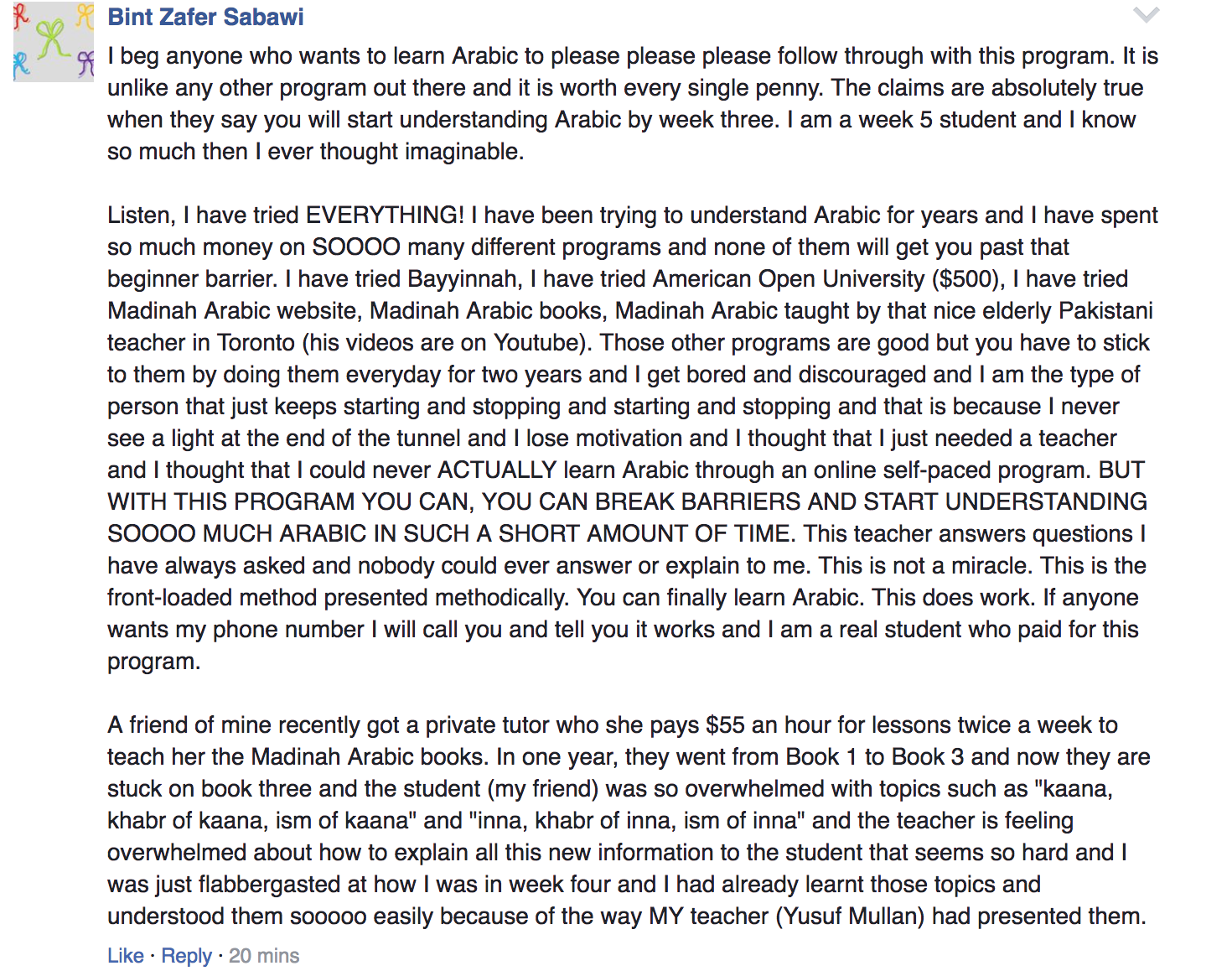
Here's a screenshot of one posted on Facebook. Many others can be seen in the comments of my 3-hour workshop.
About the Methodology
"the bold step he takes in getting the student into the heart of the Arabic language through ‘the stories of the prophets’ just after a few weeks of schooling in Arabic is unheard of but it is highly effective because while giving the opportunity to the student to apply and understand the theory (morphology and syntax in general), it also keeps him/her not only challenged but also motivated and interested…this is what the other courses fail to achieve!"
- oumardia
“Within first few weeks I realized the structure of this course meant that it was adding to everything I had been exposed to and forming a much clearer map of the language. The course has never felt boring despite my previous exposure and the students are always being stretched and steadily taken to the next level”.
- Faisal Khan
About the Resources
"I showed a friend the material available for each lesson. She was stunned. The fact that the video is backed up by a transcript and with an abstracted handout and table when appropriate, is the greatest and most brilliant idea I have ever seen or experienced... I would also add that the fact that you have distilled your experience of the past ten or more years in such a way as to present the material in a logically and chronologically coherent manner, contributes to your method as an unqualified success. "
-Shakira, Palestine
About Being Skeptical Before Joining
"This is my third series of Arabic classes. I’ve previously attended an Islamic school for three years, and I also took a year of Arabic classes in college, and I can honestly say that I’ve learned far more here in three months than I did in my four prior years in Arabic instruction. Not only that, but what I have learned I am also able to understand and recall far better than anything I learned from my other attempts at learning the language.
“This is truly a remarkable system, Mashallah. I was somewhat skeptical that the course would be as good as I had heard, but it definitely exceeded my expectations. Everything that is taught is taught in an amazingly efficient manner, with each issue being brought up multiple times, with each instance increasing the depth of the discussion at a controlled rate, so that by the time a subject is taught in exhaustive detail, the subject will already have been brought up multiple times. It really just flows”.
- Farhad Akbari, San Diego
“alhamdulillah I feel like I’m getting much more than my money’s worth and really your program is the answer to my dua’s of wanting to learn arabic seriously. I used to read the website and the testimonials and think that it was all just hype to get people to sign up, but now I can’t stop gushing about it to other people I know having similar problems as I had with finding the right course. Within the 7-8 weeks of recordings you have summed up what I have learned with 3-4 years of part time studies and more, and I’ve understood the concepts much more clearly than before. So I just wanted to say jazakallah for offering the course as I’m really excited to see what else I learn as I go on inshallah”.
- Fariha Siddiquie, Toronto
More in a Few Months Than an Entire Bachelor's Degree
Here's Br. Tauhid Rashad who drove over from Detroit, Michigan for a 5-day intensive I conducted here in Toronto.
How Can I Join the Program?
If what I’ve shared with you here has increased your dedication and made you want to understand more and more of the messages Allah has willed for you, then please read this part carefully.
Allah Most High chose Arabic as the medium for His final message because it has elements built into it that make it unique and special. One of those is its comprehensiveness and its ability to communicate through mere vowels what other languages would need entire words to express. There’s a mechanism that governs the conveyance of these “non-word meanings.”
Learning this mechanism first is what gets you to your goals in the easiest, fastest and most results-certain way.
This is where speed matters. Without it, you lose momentum, get bogged down with endless lists of rules that seem random, and eventually quit. With it, you begin reading much earlier, you start connecting dots naturally, and you build confidence week after week.
This program has been running, uninterrupted, for over 20 years, alhamdulillah. You’ll be studying through a proven methodology that has worked for thousands, and at every stage you’ll only be learning what you actually need.
Does it require work? Yes — but what thing worth achieving doesn’t? The good news is that the hardest work is front-loaded into just 4–5 weeks of study.
You won’t have to wait long for the payoff. Within weeks, you’ll already be reading your first Arabic book. Even the early, more challenging weeks are fascinating. There is nothing in this program that is tedious.
If all of this sounds good, I’d like to invite you to join, in shaa Allah.
Registration is currently closed as I'm in the middle of a major round of updates to the course materials. We will be reopening in the next few days. So if you're really excited about joining, one thing you can do is click the button below and get on the early-bird list.
This way you'll have a chance to join the program before anyone else and you're pretty much guaranteed a spot. If you're not at that point, then that's perfectly fine. Just watch the free videos I'll send you over the next few days. You'll get great value from them regardless of whether you choose to invest in the main program or not. These concepts will help you. So either way, you'll be getting some great education, insha Allah.
Still Have Questions?
Q. This sounds too good to be true, how do I know it's for real?
A: Upon first glance, it does. But when you suspend your disbelief and watch just the first 40 minutes of the 3-hour workshop available on YouTube, you begin seeing how it really is possible to get to these levels in such short periods of time.
There’s really no magic to it. It’s about taking the core of the language and teaching it first.
If other institutions did the same, they would experience similar results.
Q. I'm only a beginner, and I don't even read Qur'an very fluently yet, is this course right for me?
A: There’s a huge bonus package attached to this offer. It includes an 11 hour Foundations course which will get you up to speed so your pronunciation and taj-weed are perfect. This Foundations course BONUS does NOT assume the student can read Arabic script. It starts from the very basics.
Q. I've heard that the course is expensive, what if I don't have that full amount?
A: This program teaches a whole language with your specific goals in mind.
With that said, there will be a convenient installment-plan with the offer when we re-open registration. When you sign up before the deadline, you’ll be able to spread the cost over many months.
Q. Other teachers claim that the main barrier in Arabic isn’t how it’s taught, but that students lose motivation without accountability, so if a program simplifies the steps and gives you a teacher to push you, won’t you succeed?
A: The reason you’ve heard that line is because the promoter saying it doesn’t even understand the distinctions I’ve shared with you on this page, let alone know how to resolve them. By now, if you’ve read this far, you actually know more about the real obstacles to Arabic than he does.
Accountability and structure are valuable, of course. But they cannot compensate for a faulty method. If the underlying approach is flawed — for example, focusing on vocabulary lists while ignoring the structural rules that actually carry meaning — then no amount of reminders, one-on-one calls, or “next step” checklists will lead to real comprehension.
The difference is this: our program removes the guesswork not just by telling you what to do next, but by teaching you the right things in the right order. We front-load the high-impact core of Arabic that makes the language readable in weeks, not years. That’s why students who follow this sequence don’t just “stay accountable”, they actually succeed.
Q. I’ve heard that you shouldn’t study Arabic grammar until you can already follow an entire grammar lesson explained in Arabic. Until then, the advice is to just build vocabulary and learn naturally like a child does. Isn’t that a better path?
A: It sounds reasonable at first, but it collapses on closer look. Children acquire their first language through years of immersion and correction. Adults don’t have that luxury. For adults, delaying grammar means memorizing vocabulary without structure, which quickly turns into confusion and fossilized mistakes.
Arabic isn’t like English where you can “just know” something is wrong by feel. In Arabic, a single vowel changes who did the action and who received it. Without the rules, you’re forced to guess, and you’ll guess wrong.
The traditional path never delayed grammar like this. It front-loaded the small core of rules that unlock most of the language, then immediately applied them in reading. That’s why our students start reading in weeks, not years. Vocabulary only becomes useful once the structure is in place.
And the reason you may have heard otherwise is simple. The person giving that advice doesn’t even see these distinctions. When you don’t understand how grammar and vocabulary actually work together, the only thing left is to tell people to delay grammar and hope practice alone will fix it. But that is bad advice, and it leaves learners stuck at the very point they wanted to move past.
Q. Do you teach any of your classes through the Arabic medium?
A: We did for a number of years. Some of our classes were taught entirely in Arabic, but the results weren’t good. Students felt overwhelmed, their motivation dropped, and progress slowed. We eventually phased it out.
The reason is simple. When you’re teaching a large amount of high-impact grammar very quickly, clarity is the most important thing. That clarity is best delivered in plain English, so students grasp the concepts fully and can immediately apply them to real Arabic texts. Within a few short months, they’re already able to understand the great Arabic lectures of scholars on YouTube with complete comprehension.
The idea that a program isn’t “real” unless it’s taught in Arabic is just a myth — and it usually comes from people who haven’t thought deeply about how adults actually learn. What matters isn’t the classroom language, but whether you can reach the point of understanding Arabic directly. That’s the real test of whether a method works.
Q. What part of your program helps me develop conversational fluency? Do you have dedicated speaking practice sessions?
A: Our program is designed first and foremost for students who want to understand the Qur’an and classical Islamic texts with precision. That’s the goal, and that’s why we focus entirely on comprehension. Conversational fluency is not a primary outcome of this program, and for many of our students it isn’t even a secondary goal.
That being said, if you already understand how Arabic works, the transition from comprehension to composition is straightforward. I’ve shared a short two-minute video on my YouTube channel that explains the back translation method, which is the most powerful way to build sentence-forming ability on your own. That will give you about 90% of what’s needed to speak fluently. The other 10% is confidence, which you can build by hiring a tutor and practicing live.
So if your main objective is conversational Arabic, this program isn’t the right fit. But if your goal is to finally read and understand the Arabic of revelation and the Islamic tradition, you will not find a better program than this.
Q. I have a very busy schedule, will I be able to find time to study?
A: If you’re busy, then you need this method more than others. In fact, it might be the ONLY method appropriate for your needs.
Because it gets straight to the heart of what makes the language work and teaches you only the most incredibly important aspects that you need to know.
You end up saving hundreds of hours of precious time, totally enthusiastic and eager to move to the next lesson. No other method can accomplish all this in such an optimal way.
My 3-hour workshop available on YouTube was only the tip of the iceberg.
Besides, this is not a luxury but rather a necessity.
When we asked our students what was the biggest transformation they’ve experienced since signing up for the program, Br. Jamil Afridi said the biggest transformation he experienced was:
“The hope that insha-Allah, on the Day of Judgement, I shall not be standing alongside those unfortunate believers, who, despite considering themselves devout muslims, could not put in enough effort to learn the language of the Quran”.
Further, the program itself has elements engineered into it from the get go that will make learning FUN. It will be more recreational for you than anything remotely resembling tedious study.
As for the weekly commitment, it’s totally up to you. That’s the convenience of the Self Paced Program.
Q. Why is there a price tag at all? Why don’t you just teach for free?
A: To tell you the truth, the thought crossed my mind too and I actually tried waiving tuition fees a few years back.
And you know what happened?
Some students started to not take the classes so seriously anymore (I guess if something is free, people start to not value it so much). And others felt awkward and uncomfortable that they were taking so much of my time and effort and not giving anything in return.
So, I brought back the tuition fees and students actually thanked me for it.
You see, the pursuit of knowledge requires some level of commitment and sacrifice. Whether it’s scholars of the past leaving their families and traveling great distances to seek knowledge or students of today submitting tuition – some level of commitment and sacrifice is necessary to keep you focused throughout this journey.
Of course, your tuition also makes it possible for me, and my team to commit ourselves full time to bringing you the best possible Arabic education you can get. And it gives us the resources to improve the program month after month, year after year, alhamdulillah.
Furthermore, your tuition enables us to promote this approach to learning Classical Arabic far and wide.
Q. What are the timings for the live classes and what happens if I miss a class?
A: Classes are held on Saturday and Sunday mornings at 8:15 Eastern (1:15 PM GMT) to cater to people in all time zones.
Every class is archived and recorded. So in the middle of the week you’ll be getting an email specifying what videos you need to watch before the Sunday class and also that email will contain links to the replay of the previous weeks 2 classes.
So if you ever miss a class you can catch the replay before the next class.
Q. What's the purpose of these live classes?
A: 90% of the actual learning happens through the grounding materials at our membership portal. Your access to all of these resources is for life. The interactive live component is there to enhance your learning experience.
It gives me an opportunity to re-cover major topics using newer approaches that I’ve developed since the last time the videos were produced. Because recreating the materials from scratch cannot happen every single year. So these live classes provide the platform where you can hear my newest insights. The Sunday classes in particular are for rehearsing verb tables.
Furthermore, if you’re an intermediate student that can safely merge into an existing class, please let us know, and we’ll tel you which classes are currently in session. This way, you might not need to wait for the next start-date.
Q. If I attend the live classes and fall behind, can I restart with the next batch for free?
A: Yes. The live classes start twice a year.
Keep in mind that we do have breaks throughout the year. For example, we follow a 4-weeks-on-1-week-off schedule so after 4 weeks of continuous classes there will be a week off. Additionally, there are no classes during the month of Ramadan.
So whenever you find yourself slightly behind, if you make use of these breaks properly you could catch up before the next class.
Having said all of that, you may re-attend from the next semester at no extra charge.
Q: I’m more of a self-learner and don’t need extra accountability. Do I really need to attend the live classes to benefit?
A: Absolutely not. As I mentioned earlier, around 90% of the learning happens through the grounding materials inside the student portal. Since your access to these resources is for life, your learning is truly self-paced and you can go as fast or as slow as you want.
That being said, it still makes sense to at least take advantage of the replays of the live classes. The reason is simple: the core video lessons are not recreated every single year, but in the live classes I often explain the same concepts in newer and even clearer ways, based on the refinements I’ve developed since recording the original lessons. Many students have found that these fresh explanations deepen their understanding far beyond what’s in the recorded materials alone.
So, no — you don’t need the live classes in order to benefit. But having them available, even just as replays, is like having an extra layer of clarity and support whenever you want it.
Didn’t find your question here?
Shoot us an email at info@shariahprogram.ca and we’ll get back to you. Most emails are answered the same day, but since messages are checked once or twice, it might be later in the day. Either way, you’ll hear back soon.
Have You Heard What Other Students Are Saying?
"I am a father of 9, so time is a luxury that I don't always have. I have tried for several years to learn the Arabic language and this course has allowed me to achieve more in the past 15 months then I have in all my previous years collectively".
- Kyree Spain, New Jersey
"I took one year of University Arabic course and came out with zero understanding of morphology and grammar. But just few weeks after enrolling in the Shariah Program, I started to understand portions of what the Imam recites from the Holy Quran during salat "
- Kasim Ali
"Within the first few weeks of Shariah Program I had covered in a year [of my studies] of my weekend madrasah with much deeper understanding. And alhumudlillah after a year of Shariah Program I was able to read books with considerable understanding."
- Saad Anjum
"I don’t know of anything comparable being offered elsewhere in Canada or the US in English. WHAT YOU COVER IN THIS COURSE IS WHAT PEOPLE GO OVERSEAS TO SYRIA, PAKISTAN AND ELSEWHERE FOR. I spent 9 months in Damascus studying Arabic and this course is better organized and more thorough, and you can take it without quitting your job. If this had been offered then I wouldn’t have needed to go..."
-Waqar Ali Khan, Canada
"When i first read comments raving about shariah programme, i thought they were abit over the top until i started the course… subhanallah wow! It really is the only course outside the middle east that teaches arabic as of you were studying under a sheikh abroad."
- Zakra Ahmad
"I had almost given up on learning the language... But since finding this program, I have changed that mind-set. I no longer feel stupid, and am now comfortable with knowing that I will be fluent in Arabic just as much as I am with English (InshaAllah) due to what’s provided in this program... I must say the Shariah Program has given me so much confidence."
- Shabba Shakkas
"One thing i have picked up from the teacher is his clever way of making you believe you can do it and changing your mindset regarding Arabic as a whole. Mulana Yusuf will either say, "if you got that then its really good, " or, “if your confused then even that is good because it shows that your mind is working!!” Simply brilliant."
- Wisdom
“I feel the spiritual benefit of it already… (I am 63)… All these years I have studied, I thought I was just a poor learner, but I can see that what I was taught and the manner of how I was taught was inferior.”
-Yousef
(older student with vision and hearing limitations)
"[The] big-picture approach brings about an attitude of commitment in the student that so many other courses fail to develop."
- Danish Muzaffar Barey
“I heard about Shariah Program a few years ago and because I was doing another Arabic course, I did not start with Sharia Program. I am really glad and all praise is due to Allah that I did not put it off any longer, because what I have realized, since joining is that Sharia Program taught in 13 weeks what took 3 years+ in the other course”.
- Farida
"I expected a lot from the programme and i ve not been dissappointed. I dont know how it happened but with only few weeks into the study materials, i am competing favorably with my friends who have been studying the language for close to 2-3 years."
-Abass Badmuss
"...above all, I received a lot of information which I had not come across in previous attempts in studying the language. And I think the methodology in getting across the core of the language and then expand on it is unique and very effective. It also keeps one's attention focused in looking forward to subsequent lessons. "
-Yinka Lawal
"Alhamdulillah I am so very pleased with my classes at the Shariah Program. I've been studying Arabic since I'm Muslim more than 35 years however, I'm just now beginning to get it. The classes are available on a consistent basis and everything is made so clear, easy and to the point. After studying in Egypt, Sudan and Singapore plus in the USA none has presented the classes in a consistent clear way as the Shariah Program."
-Amatullah V. Abdul-Karim, USA
"I have been studying Arabic for a decade but seen nothing like it. There is no replacement for this in our English world. All the books written on teaching Arabic fall below par to the standard set by Shaykh Mufti Yusuf Mullan".
-Yasin Shaikh
"This course, for me, was the first and only opportunity for a sister to really excel in the Arabic language. What I can get and have gained from this course I don't think any sister in the world can get it elsewhere and I am sure of it."
-Safiya Bint Ahmed, U.K.
"I'd read and heard about various online programs to learn Arabic and grammar and Shariah Program was always at the top of the list. Shariah Program has exceeded any expectations I had as it seems to be a madrassah level education offered online. I hoped to be able to recognize a few words here and there when reading Quran. I had no idea that we were going to be studying Arabic to the depths that we are masha Allah."
-Muminah Ahmad, Philadelphia
"I remember that following Ramadan, I would prepare a juz each night before taraweeh focusing on iraab, scanning through the english if need be and then stand with so much happiness and gratefulness as I listened to it being recited. I was able to follow every word alhamdullillah!"
-Javeria Memon
“Last week, I heard a Khutbah after Fajr in which I understood almost everything I have heard. It was such an ecstatic moment for me in my Arabic learning…. to tell you all the truth, I was probably one of the worst students in the first 6 months… I resolved to myself that I would not only catch up but also try to be one of the best students in my class…. my family, friends and colleagues say that I am a person who is hard-to-please. Here in TSP, my experience has just been the opposite. I am pleased with the course from Day 1 till now”.
- Siraj from Geneva
"I had almost started believing that online programs cannot deliver on the real stuff... But after 10-11 months in your program, my faith is restored that it can be done"
-Ali Abidi, Baton Rouge, Louisiana
"When i first started looking for arabic online course...i was skeptical about the promises made by mufti saab.....especially when mufti saab said we will be reading untexted book after 6 months..i just cloudnt understand how that would be possible since students spend so many years going to in university to learning arabic....i used to think what is so special about this course......But even since i joined Masha-Allaah TabarakAllaah...i can see the promises of mufti saab coming true....its just amazing how this course is structured to ensure that the student get the maximum benefit and learning complicated things within a short span of time..."
-Nargis Begum
"The moment I came across this program, I grabbed it, it was like my prayers are answered. This is the most comprehensive, well structured program and very easy to understand. "
-Shada Malik, UK
"Shariah program has far exceeded my expectations. It is not as expensive as many other programs, yet the benefit from the course is unbelievable.
It only requires around 7 hours a week, which is definitely reasonable. Alhamdulillah, each time I hear the Qur'an I'm able to understand more and more with every passing week. I'm only 5 months into the program but have already paid for the entire 2 years because I am confident in Mufti Yusuf's talent in teaching Arabic, mashaAllah.
In fact, I am now more focused and passionate about learning Arabic than I am about my Masters degree."
- Syed Idris, Toronto, Canada
"I have taught University for years and never seen anyone motivate students with your zeal and humble way of “I too am learning … see it’s not too hard for you."
-Mukhtar B. PhD.
"I pray Allah Most High preserves this program and all involved as it has enhanced the quality of my life, my deen, and foremost my understanding of the arabic language 100 fold and has truly started to unravel for me the true miracle of kalaamullah."
-myaseen74
"At first the energy of the presentations attracted me. They come with the confidence a good teacher must hold for his pupils. He must see their potential when they cannot. No amount of detailed instruction can replace this."
- Barry Nur
"I am moving very slowly but what is invaluable is not only Mufti Yusuf’s expertise but his absolute conviction that it is achievable. That inspires me to continue. Everything is there that I need to accomplish the goal.
My life is extremely busy and so I do not have the possibility to move as fast as I would like but the structure of the course gives me the flexibility to move at my own pace."
- Leanne Day
"After I came across this course, I felt as though my prayer had been answered. It is so exciting to know that that I can access the Arabic language from the confines of my own home under the guidance of a dedicated teacher who will assist and support his students as they progress further at the flexibility of their own learning pace."
- Ridhwana
".. I had (and still have) a bookshelf FULL of Arabic learning resourses, I have all the volumes of al kitaabul Asaasi, al ‘arabiyyatu bayna yadayk, ibn sa’ud university curriculum, al kitab fii taallumil ‘arabiyyah and many more. Of course I didn’t get through them all and neither did I succeed in fully comprehending all the lessons, I probably would have still been at it, maybe even given up. Anyway after 6 months studying at Shariah Program, I could comfortably open any of the textbooks and understand almost all of it. I don’t really need to use them anyway. Alhamdulillah. And that’s no exaggeration! It was the best decision I had made and I’m still around learning new things every week."
– Rahima
"I have found it to be very true that you don't need to worry about not understanding everything the first time it is covered. As concepts are covered over and over again through the Qasas book. I have found slowly but surely everything starts to fall into place. I love the fact we are learning the grammar whilst actually translating a book, so the grammar isn't just theory, but comes to life! It is great being able to listen/watch the recordings as many times as needed and reassuring to know that any questions and queries can be asked anytime on the forum."
- Saliha Chaudhri
"The best thing about the program was the fact that the same concept was repeated so many times that it just settled in the brain. The same was with the vocabulary, because of the repetitive usage of it, I just learned it with minimal effort alhumdulilah."
- Faryal
"I have studied with Mufti Yusuf for about 3 years… Alhamdulillah… I have benefitted so much to the point of being able to read books I was wishing to read for many years. I have read almost 2/3rds of Imam Sabooni’s SafwatulTafsir, as well as the explanation of RiyadasSaliheen by Shaykh Uthaymeen, and have been able to listen to the lectures of the great ulema online who’s lectures are mostly in Arabic. So along with this program and your own personal dedication you can definitely go far. Most of All understanding the Quran is the greatest of the blessings of learning the language!"
- Khaled Hasan
"You've taken a language that seems like an enigma to most people and are handing it to them on a silver platter, all they need to do is to make some effort to do well. Usually when you take a course, there are a lot of variables in order for you to succeed. Such as the course layout, the teacher, course material, course presentation, then the student, their interest, their motivation and effort. I feel I can safely say that, in this Arabic course, you've made these variables into non-variables. The course layout, methodology, the teacher, material and presentation are excellent and constantly getting even better. So a prospective student should only worry about their own variables, because this course undoubtedly will get you there. You just need to prepare for the journey. Its like getting on a plane, as you prepare for the trip, you’re not really thinking about the pilots ability to fly, the engine’s capability to run, etc. Those are given. You’re only worried about being ready, being packed, getting to the airport on time. etc. That is how this is."
There's many more testimonials and reviews that can be listed here, but I think you get the point. This is the real deal.
This brings us to the end of this letter.
If you scrolled down to get the bottom line, here it is:
I’m in the middle of a major round of updates to the course materials. To make room for this work, registration is currently closed.
If you're excited about joining as soon as we re-open registration, click the button below and begin entering your information on the next page.