
The Last 4 Letters of
the Alphabet
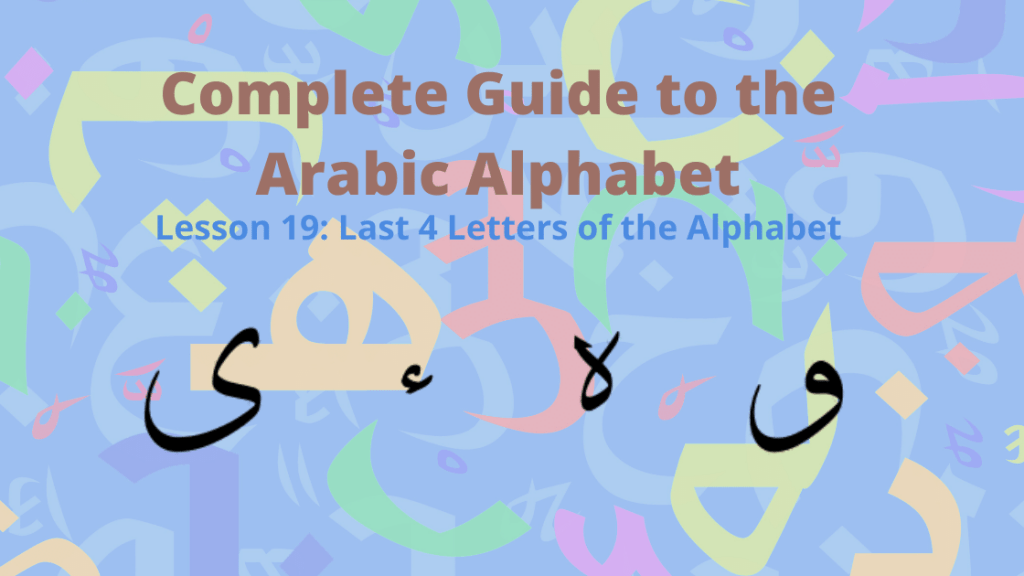
· The last 4 letters of the alphabet are as follows
| و | W |
| ه | H |
| ء | A |
| ي | Y |

· Waw is equivalent to W
· Haa is kind of like H, and it’s different from the Haa we learned in Jeem, Haa, KHaa
·
Hamza is like the letter A,
except it’s not a vowel
We’ll explain this in detail in the lesson
Hamza is the only letter whose name doesn’t reflect how it sounds
· Yaa is equivalent to Y
·
Waw and Yaa can also be
used as long vowels like Aleph
We’ll talk about this in the lesson
· Let’s learn these letters in a different order for convenience
Haa
·
This Haa is different from
the Haa we learned in Jeem, Haa, KHaa
That one was really throaty
This one sounds like the noise you make when you say “Ugh” when you’re annoyed
· See the difference between ح and ه by comparing these two words
| حَبَّ |
| هَبَّ |
·
In English H, your breath
starts from the center of your mouth (try it)
In Arabic ح, your breath starts from the middle of
your throat (near the area labelled Larynx)
In Arabic ه, your breath starts from the bottom of
your throat (near the area labelled Trachea)
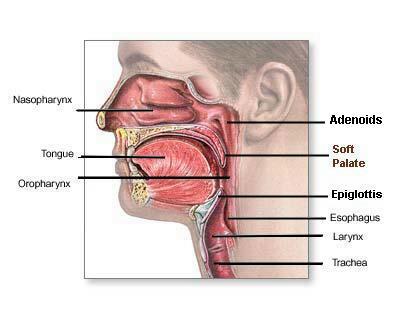
Source: http://www.doctorspiller.com/oral%20anatomy.htm
· Exercise: how many ح and how many ه do you hear in these recordings
| Answer [0 and 4] |
| Answer [1 and 1] |
| Answer [2 and 4] |
· Exercise: repeat the following
|
|
|
· ه is written a follows
end | middle | beginning | by itself |
ـه | ـهـ | هـ | ه |
·
To write the Haa in the
beginning of a sequence:
Start from the top and draw a curve like you’re drawing a Daal
When you’re about to finish drawing the Daal, go into a loop
The top of the loop should touch the point where the Daal started
· Try to look at the Haa (beginning version) and see if you can tell that the Haa was drawn like you just learned
· Looking at a big version might help:
هـ
·
Look at the Haa (middle
version)
This is how you’ll see it most of the time when its printed by computer
But when you write it by hand, you usually only draw the bottom half
It will kind of look like the letter V written below the line
· Exercise: copy the following words
هذه
هَلُمَّ
بُهْتانُ
فَهارِسْ
ذَهَبَ
رِهانُ
صَهْ
بَلَدُهُ
· Exercise: copy the words you hear
| Answer [حامِلْ] |
| Answer [بُهْتَ] |
| Answer [مِثْقالُها] |
· Remember: the letter Taa (from Baa, Taa, THaa) is sometimes written like this Haa. Below are some examples
فخامة،
سلطنة
حبرة،
مباراة
·
What do I call this letter?
It’s a Taa, not a Haa
ة = ت
·
When is Taa written like
this?
This only happens at the end of a word (not necessarily the end of a
sequence)
·
How do I know where the end
of a word is?
You don’t. You need to know Arabic to figure that out
But if you see this ة, you know you’re at the end of a word
·
So if a Taa is at the end
of a word, it will always be written like this?
No. Sometimes it’s written like normal, and sometimes like this
·
Why? Is it a choice?
No. It has to do with grammatical gender; it’s NOT a choice
The following words are two different words
كرهة،
كرهت
·
How do I write it?
The body looks like Haa but there are 2 dots on top
end | middle | beginning | by itself |
ـة | ة |
·
I pronounce it exactly like
Taa, right?
Not exactly. If this Taa has a vowel on it, it will sound like Taa
If it is Saakin, though, it will sound like Haa
· In Arabic, when you’re finishing a sentence (or a flow of speech), you typically don’t pronounce the vowel on the last letter; you make it Saakin in pronunciation
·
So if the last letter in a
sentence is this Taa, you will probably want to make it sound Saakin
So it will be pronounced like a Haa
·
Okay wait. If someone
finishes a sentence with this Haa sound, how do I know if it was a Taa (that
they chose to make Saakin), or actually a Haa?
You don’t. You will be able to tell once you study Arabic grammar, though
·
Click on the following
words to hear them
Notice: it’s kind of hard to hear the Taa when you pronounce it like a Haa
|
قَصَدْتُ |
ضَرْبَةُ |
كُرَةُ
سَّلَّةِ |
·
Side note:
Notice in قصدت that the Daal and Taa kind of sound the
same
This is one of those cases like ط and ت
where you mix the letters because they sound the same
We suggest taking
a break now before continuing with the lesson
Waw & Yaa
· Waw sounds like W and Yaa sounds like Y
| وَلِيَ |
· But Waw and Yaa can be used in 3 different ways:
1.
The first way to use Waw
and Yaa is as consonants
This happens when they have vowels on top / underneath them
Exercise: repeat the words you hear
|
|
|
2.
The second way to use Waw
and Yaa is as long vowels
This happens when:
a. They are Saakin
b.
And the (short)
vowel on the letter before them matches them
In other words, a Waw is Saakin and it has a Damma before it, or a Yaa is
Saakin and it has a Kasra before it
In this case, the Waw will stretch the
Damma and the Yaa will stretch the Kasra
This is how Alpeh stretches the Fatha before it
Exercise: repeat the words you hear
|
|
|
3.
The third way to use Waw
and Yaa is as diphthongs
This happens when:
a. They are Saakin
b. And the (short) vowel on the letter before them is a Fatha
In this case, the Waw will sound like the
“ou” in “out” and the Yaa will sound like the “ei” in the name “Hussein”
Exercise: repeat the words you hear
|
|
|
·
So now we know all the
short vowels (Fatha, Damma, Kasra)
And all the long vowels that stretch these (Aleph, Waw, Yaa)
|
بِ |
بُ |
بَ |
|
بِيْ |
بُوْ |
با |
· We also learned that Arabic has 2 diphthongs (or you can call them semi-vowels)
· Arabic does NOT have the other two diphthongs (listed below)
· Waw and Yaa are written like this:
end | middle | beginning | by itself |
ـو | ـوـ | و ـ | و |
ـي | ـيـ | يـ | ي |
· Note: Waw does not connect to the letter following it
· Waw looks like a Raa except that it has a tiny loop at the top
·
Yaa has the same body as
Baa/Taa/THaa/Noon
But it has 2 dots underneath
end | middle | beginning | by itself |
ـن | ـنـ | نـ | ن |
ـب | ـبـ | بـ | ب |
ـت | ـتـ | تـ | ت |
ـي | ـيـ | يـ | ي |
ـث | ـثـ | ثـ | ث |
· The similarity between these letters is in the beginning and middle of a sequence
· Use the number and position of the dots to help you
·
Yaa is like an S with a
very long tail
Notice that the entire letter goes underneath the line when the Yaa is at the
end of a sequence
·
Sometimes Yaa is written
without its 2 dots
This only happens at the end of word
end | middle | beginning | by itself |
ـى | ى |
·
This is actually NOT a
Yaa
It’s an Aleph
·
This might seem confusing
But, in Arabic grammar, it’s really, really convenient
How is that convenient? To find out, learn
some Arabic
· Exercise: read the following
|
مَيْمُوْنَةَ |
يَعُوْقَ |
سُواعَ |
|
عَلى |
مِيْزانَ |
يا مَوْلى |
We suggest taking
a break now before continuing with the lesson
Hamza
· Hamza sounds like the letter A
| ءَكَلَ |
·
But it’s not a vowel
(Fatha is the A vowel in Arabic)
·
Hamza is just a consonant
There is no equivalent consonant in English
It sounds like the “AAAA” sound you make when you’re thinking
·
If you want this sound in
English, you just use the vowel A
Like in the word “Apple”
·
In Arabic, if we pronounce
the word “Apple”, we don’t say we’re starting with a Fatha vowel
We say we’re starting with a Hamza and the Hamza has a Fatha after it
·
So, in Arabic, the sound A
as in “Apple” is really a combination of a Hamza consonant followed by a Fatha
vowel
In English, the whole sequence is considered a vowel
· Exercise: do you hear a Hamza in these recordings?
| Answer [YES] |
| Answer [YES] |
| Answer [YES] |
· When a Hamza is Saakin, it sounds like an abrupt jerking noise
| بُءْسُ |
· Exercise: do you hear a Hamza in these recordings?
| Answer [NO] |
| Answer [YES; 4] |
| Answer [YES; 4] |
· Writing Hamza is a complicated issue
We’ll discuss it in an advanced lesson
· But these are the forms it can take
o By itself
o On top of an Aleph
o Underneath an Aleph
o On top of a Waw
o On top of a Yaa (the Yaa won’t have dots)
· Just look for the Hamza symbol to figure it out when you’re reading
· Exercise: read the following
|
إِهانَةْ |
أُصُوْلُ |
أَساتِذَةُ |
|
بِئْسَ |
بَأْسَ |
بُؤْسَ |
|
شَيْءَ |
جِيْءَ |
تَفاءَلَ |
|
عِبْ
ءُ |
رَأَوْ |
مَلْجَأَ |
· Notice that when a Hamza is written on its own, it does not connect to the following letter
· Now we’ve seen all the letters that do not connect to the following letter
ا, د, ذ, ر, ز, و, (and in
some cases) ء
This lesson was authored by Mohtanick Jamil
FREE Course
-
LEVEL 1
- 1 About the Arabic Alphabet
- 2 Letter Aleph
- 3 Letters Baa, Taa, THaa
- 4 Vowel Fatha
- 5 Lesson Review
- 6 Letters Jeem, Haa, KHaa
- 7 Reading & Writing Review
- 8 Letters Daal, Dhaal
- 9 Letters Raa, Zeiy
- 10 Pronunciation Review
- 11 Letters Seen, SHeen
- 12 Letters Saad, Daad
- 13 Vowels Kasra, Damma
- 14 Letters Taa, Zaa
- 15 Letters Ein, GHein
- 16 Arabic Syllables
- 17 Letters Faa, Qaaf, Kaaf
- 18 Letters Laam, Meem, Noon
- 19 Rest of the Alphabet
- 20 Review & Practice
- 21 Double Vowel
- 22 Reading Arabic Sentences
LEVEL 2
LEVEL 3
LEVEL 4
LEVEL 5